For Better Innovation, For Better Research,
And Against
Forms Of Abuse of Power
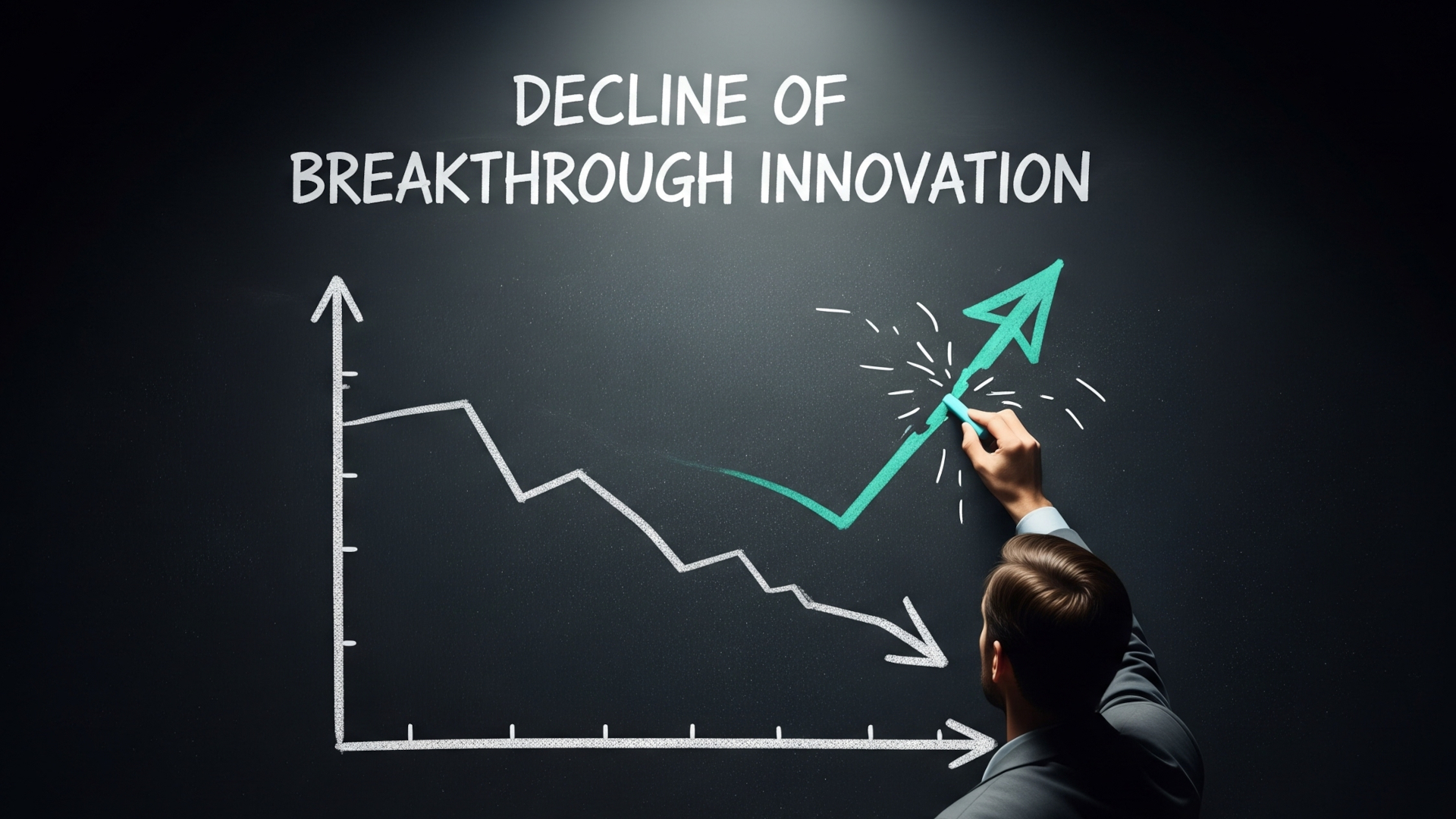
The Decline of Scientific Innovation
In a 2024 article titled "The Worrisome Decline in Breakthrough Innovation", published in the platform KNOWLEDGE managed by the
ESSEC Business School, Radu Vranceanu proposes a review arguing
that multiple studies have highlighted a decrease in scientific
productivity of the US since the 1970s. The researcher
particularly points at two articles by Chu and Evans (2021) and
Park et al. (2023), and at the 2023 article "Are ideas getting harder to find? A short review of the
evidence" published by Matt Clancy within the OECD Report
"Artificial Intelligence in Science: Challenges,
Opportunities and the Future of Research." This, in turn,
mentions a preceding study by Boeing and Hünermund (2020)
highlighting similar dynamics in Germany and China. The question
raised by Clancy is whether less innovative ideas are
circulating within the research sector. All these studies
suggest that, although this sector has experienced an increase
in the number of researchers overall, this increase has not been
met with a corresponding growth in the quality of research
outputs. In other words, given that the volume of publication is
ever increasing, we are publishing more and more but the quality
of our research may be decreasing. This decline suggests
potential systemic issues within the research environment
itself.
The Rise of Academic Misconduct
McCabe et al. (2001) have highlighted how cheating
in academia among university students has also increased since
the 1970s. In a more recent study, Ali et al. (2021) seem to
support that practices such as cheating, plagiarism, and
ghost-writing have increased, although they do not identify a
specific starting date for this trend. Bretag (2013) suggests
that this behavior is not confined to university students, but
it extends to established researchers as well. The same increase
of research misconduct is confirmed in "The European Code of Conduct for Research Integrity" published by All European Academies (ALLEA) in 2011,
mentioning "pressure to publish, commercialisation, greater
competition for funds, more opportunities for instance through
the internet, evaluation practices, and the current career
system for scientists" as potential drivers of these
results. Beyond general dishonesty, one unethical issue that is
perceived to be substantially affecting science is power abuse,
as Gonçalves et al. (2024) highlight how power abuse may be the most cited issue in
academia together with fraud and bullying.
The Effects of Power Abuse on Innovation
I argue that power abuse may have detrimental
effects on innovation and is potentially an important cause for
the highlighted decline of breakthrough innovation. As an
example, in the 2019 article "Does Science Advance One Funeral at a Time?," Azoulay et al. highlight how ideas in line with those
of "superstar" scientists (e.g. who received high
reputation in their respective fields) tend to find higher
publication rates as long as those superstars are alive.
Contrarily, ideas that are not in line with those ideas, tend to
experience a block in publication while those superstars are
alive, which is followed by a substantial rise in publication
after their deaths. This suggests that the position and
influence of those superstar scientists may, voluntarily or
involuntarily, stifle innovation that deviated from their
thoughts.
In addition to this subtle stifling, power
abuse may manifest directly, causing harm to careers. Power
positions within the research industry may often stifle
innovation, and the perpetrator may often remain unaccountable,
raising questions about the accountability of people at the top
of the research industry.
For example, as part of my
2025 whistleblowing initiative originally published in the blog
pointsofdiscontinuityblog.org, I reported that in 2020 I originally conceived, designed, and
wrote a project proposal titled "Points of
Discontinuity" building upon a former 2018
publication of mine
by the same title, intended for an early-career fellowship by
the Austrian Science Fund to promote young scientists and their
ideas. Eventually, the prospected mentor became the PI of the
project.
As soon as the PI officially received the
money and associated authority, my ideas (focused on the notion
of entropy, as informing the grant proposal) suddenly became a
nonsense, as it was hard in the PI's opinion to understand
how those ideas still existed. The PI dishonored our original
understanding that I would lead the project and, fundamentally,
the promotion of my ideas became unimportant, asking me to
dedicate less time to my ideas and more to the project he was
now leading. Eventually, those ideas were later published in an
international journal and officially
praised
for their level of innovation.
A similar example
highlighting how abuse of power may stifle innovation occurred
to me during a project submission to Creative Europe in 2021.
The project was rejected due to a factual error by one
peer-reviewer, who deemed the project as not meeting the minimum
requirement of the call, which was
the integration of the audiovisual sector
within the product concept. The comment of the peer-reviewer
stated that the integration of the audiovisual sector was not
demonstrated, identifying it as a critical flaw.
I
reported the factual error, which is considered by the European
Union as a valid reason for complaints, and the officer of the
EACEA denied a redress through the use of a double negative. To
deny the presence of a factual error, the EACEA officer argued
that nowhere it was written that the
audiovisual sector was not-integrated,
but simply that its integration was not demonstrated. I
eventually requested the release of my files under the EU
regulation 1049/2001 and published an investigation into the
incident with all relevant evidence in this
Zenodo repository, showing how multiple stages of the complaint process showed a
pattern to fail addressing and responding to the core
argumentation of my complaint, questioning whether this may be a
systemic issue.
The case is interesting because the
European Union defines the rejection of project proposals
through
inadequate reasoning as an
abuse of power, and the rejected project was previously
acknowledged as a top innovation by multiple initiatives like
the Horizon-2020 CLIC Startup Competition (top-9 international
projects), the Italian Alliance for Sustainable Development
(Innovability School, top-14 Italian projects in all sectors),
and the Startup Europe Accelerathon (top-4 European projects in
the Cultural & Creative Industries), which is an initiative
created by the European Commission itself to identify the best
projects that support Europe's priority goals.
The
question emerging out of these examples is not whether there may
or may not be good ideas out there, but whether the abuse of
one's power may actually stifle those ideas in various
conscious and unconscious ways, either in the forms of
peer-review or management style, and what would be the
collective price of such a practice. A number of organizations
should be devoted to monitor that the rights of researchers and
our quest for innovation are treated fairly to prevent this
observed decline, but it is a question whether these
organizations are effective.
For example, in the
former case, I reported the instance of power abuse I
experienced within the EU call for projects to the European
Ombudsman, an organization especially dedicated to investigate
cases of power abuse by EU institutions, and they declined to
open an investigation for an unclear generic reason, mentioning
that there were "no grounds" to open an investigation,
but without highlighting which grounds were missing.
Similarly,
when I reported the problem I experienced with the PI to the
Austrian Science Fund and the Austrian Agency for Scientific
Integrity, part of the evidence informing my allegations could
not be considered because of data protection regulations,
questioning what would be the purpose of collecting evidence
within a whistleblowing framework if such evidence would then
not be accounted for.
Conclusions
Given that academic misconduct is arguably on the
rise, it is still unrecognized how power abuse and dishonest
behavior actually impact scientific productivity and the future
of the research sector as a whole, resulting in an arguable
systemic issue that stifles innovation and demotivates
researchers, remaining often unaddressed. In a 2020 article
titled "Academic Dishonesty and Research Productivity in a Changing
Higher Education Environment. The Case of India’s Engineering
Institutions," Bakthavatchaalam et al. highlight that these forms of
dishonesty have the effect of demotivating future early career
researchers. Experiencing an environment where corruption and
misconduct is often unaddressed may push future researchers to
engage more with these types of behavior, having a direct
negative impact on our scientific productivity and eventually
lowering the quality of the research staff over time.
------------------------------------------------------
References
Ali, I., Sultana, P., & Aboelmaged, M. (2021).
A bibliometric analysis of academic misconduct research in
higher education: Current status and future research
opportunities.
Accountability in Research,
28(6), 372–393.
All European
Academies (ALLEA). (2011).
The European code of conduct for research integrity.
Azoulay, P., Fons-Rosen, C., & Zivin, J. S.
G. (2019). Does science advance one funeral at a time?
The American Economic Review,
109(8), 2889–2920.
Bakthavatchaalam,
V., Miles, M., Machado-Taylor, M. de L., & Sa, M. J. (2021).
Academic dishonesty and research productivity in a changing
Higher Education environment: The case of India's
engineering institutions.
Voprosy Obrazovaniya / Educational Studies Moscow, (2), 126–151.
Boeing, P.,
& Hünermund, P. (2023). Is there a slowdown in research
productivity? Evidence from China and Germany. In
Artificial intelligence in science: Challenges, opportunities
and the future of research. OECD Publishing.
Bretag, T. (2013). Challenges in
addressing plagiarism in education.
PLoS Medicine,
10(12), e1001574.
Chu, J. S.
G., & Evans, J. A. (2021). Slowed canonical progress in
large fields of science.
Proceedings of the National Academy of Sciences, 118(41), e2021636118.
Clancy,
M. (2023). Are ideas getting harder to find? A short review of
the evidence. In
Artificial intelligence in science: Challenges, opportunities
and the future of research. OECD Publishing.
Danieli, L. (2018). Points of
discontinuity and spatial cadences: Two experimental concepts
for the development of musical theory. In
Proceedings of the XXII Colloquio Informatica Musicale
(pp. 70–76).
Danieli, L. (2025a, April).
About Me.
pointsofdiscontinuityblog.org.
https://www.pointsofdiscontinuityblog.org/
Danieli, L. (2025b).
Evidence of abuse of power during a complaint process related
to a EU call for projects. Zenodo.
https://doi.org/10.5281/zenodo.17225804
Devaney, J., & Meredith, D. (2022). Editorial.
Journal of New Music Research,
51(4–5), 259–261.
Gonçalves,
F. V., Lourenço, S. S., Alegria, S. C., McCashin, D., &
Sampaio, R. (2024). Analysis of whistleblowing in academia.
Brazilian Journal of Forensic Sciences, Medical Law and
Bioethics, 12(3), 274–290.
McCabe,
D. L., Treviño, L. K., & Butterfield, K. D. (2001). Cheating
in academic institutions: A decade of research.
Ethics & Behavior,
11(3), 219–232.
Park, M.,
Leahey, E., & Funk, R. J. (2023). Papers and patents are
becoming less disruptive over time.
Nature,
613(7942), 138–144.
Vranceanu,
R. (2024, February 19).
The worrisome decline in breakthrough innovation. KNOWLEDGE, Essec Business School.
https://knowledge.essec.edu/en/innovation/the-worrisome-decline-in-breakthrough-innovation.html
Is "bad luck" sabotaging your research? Academic dishonesty and the decline of innovation
Did you know that a progressive decline in innovation has been registered after the 1960s? And simultaneously, an increase in academic dishonesty has been observed? In this video, I explore the potential systemic effects of "misfortune" on science - that is, when misfortune is blamed to cover up for unprofessional behaviors.
Top 4 things we need to change in research to start innovating again
Power abuse is not the only issue that hinders our innovation ecosystem. In this episode we go through some of the problems that contribute to the observed decline in breakthrough innovation. It includes four chapters: Publish or perish; Decline of Quality of Researchers; Science Advances On Funeral at a Time; Research Funding May Disadvantage Breakthrough Innovation.
I investigated power abuse in a EU call for innovation
Following my video on an alleged instance of power abuse during a complaint process in a EU call, I investigated the matter and requested the release of my files under Regulation 1049/2001. In this episode, I review the handling process of my complaints to the EACEA and European Ombudsman, highlighting concerning patterns of avoiding addressing the core arguments of the applicant.
I blew the whistle against academic misconduct and part of my evidence was undermined
I wrote a scientific research proposal for an Early Career Researchers grant. Upon its completion, my prospective mentor suggested that he be listed as PI, to apply for a bigger grant and support a PhD student with a scholarship, with the explicit understanding that I would lead the project. However, immediately after the grant was awarded, he sidelined my research and removed me from leadership.